Customer churn isn’t just a number — it’s a silent leak in your business pipeline.
Most SMBs treat it as an afterthought, only reacting when customers vanish.
But what if you could predict churn before it happens — and prevent nearly half of it?
That’s not wishful thinking. It’s a documented, AI-driven outcome.
In this guide, you’ll see exactly how small businesses are cutting churn by up to 43% within 90 days, using automation, behavioral data, and predictive analytics.
Put Metrics in Place (Day 1 – 10)
Goal: Establish visibility before action.
You can’t fix what you can’t measure — and most SMBs have zero visibility into what drives customer drop-off.
Start by deploying a Customer Data Platform (CDP) like Segment to unify data from your point-of-sale system, CRM, website analytics, and email campaigns.
What to track:
- Customer journey milestones (first purchase, repeat orders, inactive period)
- Behavioral triggers (time since last engagement, cart abandonment, customer support activity)
- Churn events (subscription cancellations, refund requests, inactivity over X days)
Once data flows in, define a “danger zone” event sequence.
For example:
“No purchases in 25 days + no website visit + email unopened = churn risk.”
Then set real-time alerts or Slack notifications for at-risk customers.
Team Mindset Shift:
Remind everyone:
“We’re not playing hot potato. We’re predicting friction before it turns into a fire.”
Predict Churn (Day 11 – 30)
Goal: Turn descriptive data into predictive intelligence.
Now that you’ve established metrics, it’s time to identify patterns before pain.
Use an accessible AI analytics platform like RapidMiner or Google Cloud AutoML Tables — both designed for non-data-scientists.
Import your Segment data and build a predictive model that analyzes customer history to estimate churn probability.
Focus your model on variables that matter:
- Purchase frequency
- Time since last interaction
- Lifetime value (LTV)
- Support tickets per customer
- Average order size
You’re not predicting what customers might buy next — you’re predicting when they might leave.
Pro Tip: Build a simple “Churn Score” from 0–100. Any customer over 70 gets flagged for intervention.
This step converts gut feeling into actionable foresight.
Instead of reacting to churn, you’ll intercept it.
Make AI Your Ghostwriter (Day 31 – 45)
Goal: Communicate with empathy at scale.
Once you’ve identified at-risk customers, don’t guess your messaging — generate it scientifically.
Enter Persado, an AI-driven language platform that crafts emotionally-optimized messages based on behavioral data.
Persado uses “emotion AI” to analyze past communication and predict which phrasing, tone, and sentiment produce the best outcomes for each audience segment.
For example:
- An optimistic tone works best for aspirational buyers (“Get closer to your goals”).
- A security tone works best for service renewals (“Keep your data safe and uninterrupted”).
Persado’s AI becomes your ghostwriter, drafting personalized retention messages that sound human — not robotic.
Pro Tip: Pair this with GPT-4 for experimentation.
Prompt: “Generate three variations of a retention email for customers who haven’t engaged in 21 days. One emotional, one practical, one humorous.”
Automate to Prevent Churn (Day 46 – 60)
Goal: Execute intervention at the exact right moment.
Now, deploy automation platforms like Intercom or ActiveCampaign to trigger those Persado-crafted messages automatically.
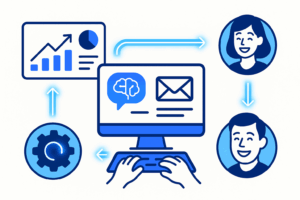
Here’s how to build your “Churn Prevention Loop”:
- Trigger: Customer reaches churn threshold (e.g., inactive for 25 days).
- Automation: Intercom sends a personalized message within 2 hours.
- Response Tracking: If the user clicks or responds, they’re removed from the churn sequence.
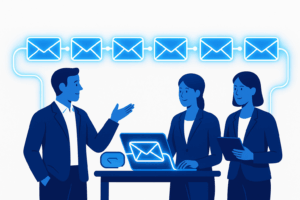
You can even layer multiple channels — email, SMS, and chat — so your interventions feel timely, not spammy.
Warning: Do not bombard your customers.
Limit outreach to two personalized touchpoints per week. Anything more turns help into harassment.
Pro Tip: Add an “AI empathy check.” Before launching, run your message through ChatGPT with the prompt:
“Rewrite this message to sound caring, not transactional.”
Test, Tweak, Repeat (Day 61 – 90)
Goal: Optimize based on real outcomes.
No system is perfect out of the gate.
Use tools like Optimizely or Google Optimize to A/B test your retention messages, triggers, and reward incentives.
Track improvements weekly:
- Message A → “We miss you” (Control)
- Message B → “Still hungry for more?” (Emotionally-driven test)
- Message C → “Order now & save 20% — your favorites are waiting” (Incentive-based test)
Monitor which variant reduces churn fastest, then scale the winner across your automation.
Pro Tip: Include behavioral rewards — not just discounts. Early-access perks or “VIP thank-you” notes drive longer retention with less revenue erosion.
In Real Numbers: Sophia’s Bistro Case Study
Sophia runs a cozy neighborhood bistro in Seattle.
She noticed her loyal customers were fading away — repeat orders were down 37%.
Here’s how she fixed it:
- Measurement:
Using Segment, Sophia tracked order frequency, engagement, and “time since last visit.”
She found her danger zone: customers who hadn’t ordered in 27 days had an 89% churn probability. - Prediction:
RapidMiner built a model around these metrics, auto-tagging customers when they neared the 27-day mark. - AI Messaging:
Persado crafted dynamic messages:
- Day 21: “Your favorite meal is waiting — shall we save you a seat?”
- Day 25: “Chef’s cooking your favorite again tonight.”
- Day 26: “A special treat — 20% off your next meal, just for you.”
- Automation:
ActiveCampaign sent each message automatically, adjusting delivery time based on prior engagement. - Optimization:
Using Optimizely, Sophia A/B tested language and timing. Emotional messaging outperformed promotional offers by 15%.
Result:
- Churn dropped from 37% to 21% within 60 days.
- After continued refinement, it stabilized at 20%.
- Annual revenue loss decreased by 43%.
Sophia didn’t just save customers — she built a repeat-order engine.
Behavioral Science Behind the Success
AI makes this process faster, but the psychology behind it is timeless.
- Personalization triggers reciprocity. When customers feel known, they give loyalty in return.
- Timing amplifies relevance. A perfectly timed message feels intuitive, not intrusive.
- Positive reinforcement builds habits. Rewarding engagement encourages repeat behavior — the foundation of retention.
By fusing behavioral insight with machine precision, you can scale empathy across thousands of customers.
The Broader Lesson: AI as a Retention Engine, Not a Replacement
This isn’t about shiny tech. It’s about building systems that protect revenue.
AI doesn’t replace human care — it replicates consistency, precision, and timeliness.
When AI does the heavy lifting, your team can focus on human-level connection — the final 10% that keeps customers for life.
Replace assumptions with analytics. Replace panic with prediction.
And turn churn into your most measurable victory of 2025.
Learn more with CONXD AI. CLICK HERE